
Understanding Homelessness in Ireland: Insights from the COMHOM Project
Homelessness is a complex and pressing issue, shaped by personal, social, and structural factors. To better understand these dynamics, the COMHOM Project conducted Phase 1 of research exploring homelessness in Ireland between October and November 2025. This involved semi-structured interviews and collaborative working sessions with people with lived experience, social service providers, and policymakers. Our goal was to uncover the realities of homelessness and identify opportunities for better services and policy interventions.
Mapping the Homelessness Journey
Our research revealed that homelessness rarely results from a single cause. Trauma, mental health challenges, substance use, family breakdown, unemployment, poverty, and systemic gaps in social and health services all intersect to create risk. For some, informal arrangements like staying with friends or family temporarily stave off homelessness. But when these options are exhausted, people often turn to local authorities or emergency accommodation.
Life during homelessness is challenging. Overcrowded shelters, limited privacy, exposure to violence, and fragmented support services contribute to instability and stress. Secure housing, stable employment, education, and social support networks are key enablers for exiting homelessness sustainably. Conversely, high rents, limited housing options, and fragmented services prolong people’s stays in temporary accommodation.
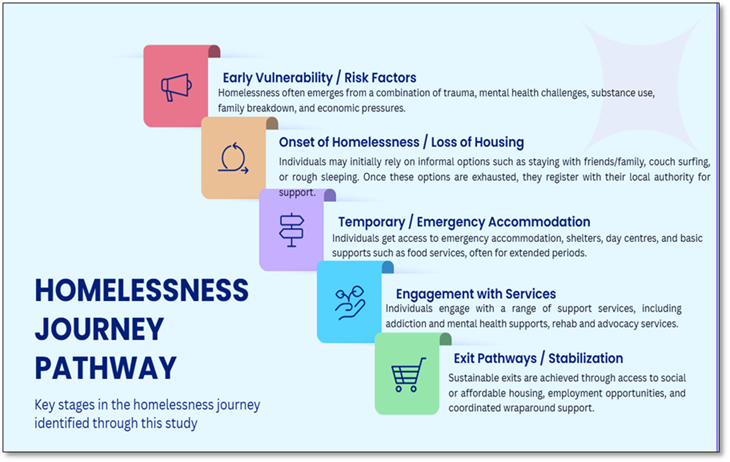
Fig. 1: Homelessness Journey Pathways
Who is Most Affected
Certain groups face higher risk, including single adults, youth leaving care, migrants, refugees, people with mental health or addiction challenges, and minority communities such as Roma and LGBTQ+ individuals. Intergenerational homelessness is also increasingly visible, with children of people who previously accessed services often returning to the system.
The Gap Between Policy and Reality
We found that official policy definitions of homelessness often underrepresent the lived realities. “Hidden” homelessness such as couch surfing, overcrowded housing, or temporary institutional care is often missed in policy statistics, particularly for vulnerable and marginalised groups.
Digital Practices in Homelessness Services
Digital tools like PASS, Salesforce, Excel, Outlook, and WhatsApp are widely used for case management, communication, reporting, and monitoring. While helpful, these tools often operate in silos, creating inefficiencies and limiting the ability to track outcomes beyond basic metrics. Our study highlights the need for an integrated digital platform to improve coordination, capture both qualitative and quantitative outcomes, and reduce duplicated effort.
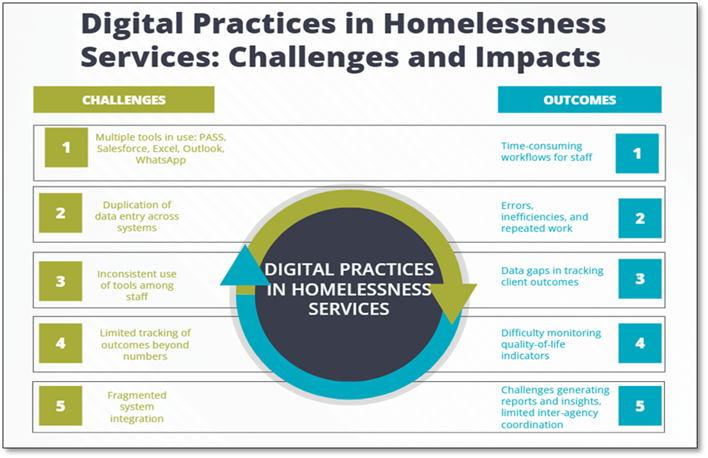
Fig 2: Digital Practices in Homelessness Services
Policy Insights
Our study found that homelessness experiences are shaped by broader structural and policy conditions. From the policymakers perspective, we noted key structural challenges affecting the sector, including shortages of housing for single people, families, older adults, and people with disabilities; regional imbalances, with Dublin accounting for 70% of homelessness; rising family and intergenerational homelessness; and high staff turnover impacting service continuity. Vulnerable groups, including women, families with children, migrants, LGBTQ+ and ethnic minorities, face additional challenges.
Critical data gaps were also observed, including limited information on minority groups, women, youth leaving care, and discharged patients; inconsistent or incomplete data collection across agencies; and difficulties tracking tenancy failures, prevention outcomes, and intergenerational trends.
These structural and data challenges contribute to prolonged stays in temporary accommodation and constrain pathways out of homelessness, highlighting the need for integrated policy and evidence-based approaches.
Better data collection, integrated systems, and EU-wide comparisons are essential for evidence-based policy-making and ensuring interventions target the most pressing needs.
Recommendations
We identified several priority areas for improvement:
- Increase social and single-room housing supply
- Develop tailored services for specific sub-populations
- Establish integrated support hubs combining housing, mental health, and social care
- Invest in sustained funding for specialist services
- Improve digital systems to streamline workflows and track outcomes
- Focus on early intervention to prevent family and intergenerational homelessness
- Adopt culturally appropriate approaches for diverse populations.
Looking Ahead
Phase 2 of the COMHOM Project will focus on co-designing digital solutions to improve system integration, service delivery, and data use across the homelessness sector. These findings also contribute to EU-wide comparisons and help identify best practices for preventing and addressing homelessness.
Acknowledgements
We sincerely thank everyone who shared their time, experience, and expertise. Your input is central to shaping more effective, human-centred, and evidence-based responses to homelessness.
The insights from Phase 1 (Problem Phase) will guide Phase 2 (Solution Phase), which focuses on co-designing digital solutions to improve service delivery and outcomes.
Author: Kenny Ogunjemilusi
The COMHOM project has received funding from the European Union’s European Social Fund (ESF+) under Grant Agreement No. 101172624